Part 3: Why Most Fashion Courses Fail (And How to Avoid It)
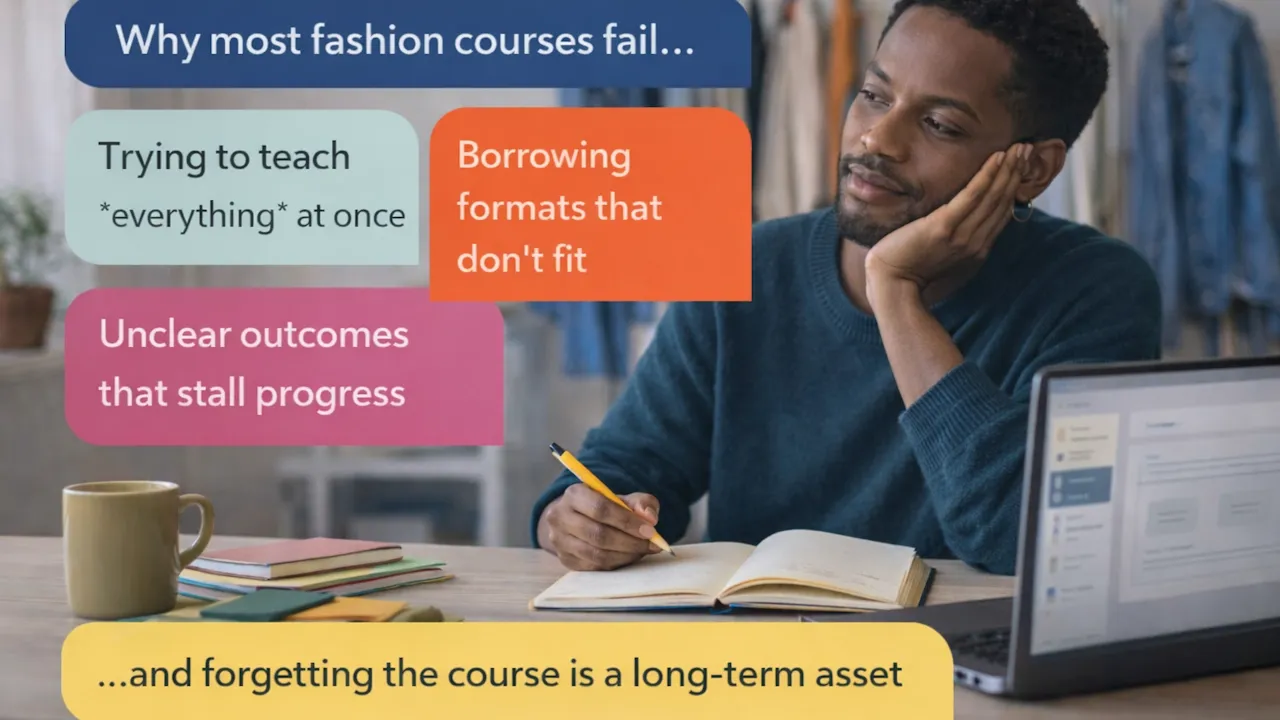
Most fashion experts don’t fail at course creation because they lack knowledge.
They fail because they try to be too responsible.
By the time someone with real experience decides to create a course, they usually feel a weight on their shoulders. A sense that if they’re going to do this, it needs to be thorough. Accurate. Complete.
And that instinct, while well-intentioned, is where things often start to go wrong.
The Most Common Mistake: Trying to Teach Everything
This is the trap I see most often.
Experienced professionals know how complex the fashion world really is. They understand the nuance, the edge cases, the things that might matter later.
So they include everything.
The result?
-
Long modules
-
Dense lessons
-
Learners who start strong… and quietly drift away
It’s not that the content is so bad.
It’s that learners don’t know where to focus first.
More content doesn’t create more value.
It usually creates more friction.
Borrowing Formats That Don’t Fit
Another common issue is copying what looks successful elsewhere.
High-energy launches. Influencer-style delivery. Constant visibility. Big personality-led formats work brilliantly for some people and feel completely wrong for others.
When the format doesn’t fit the person, confidence leaks through the cracks. And learners feel it.
Fashion experts don’t need to perform to be taken seriously.
They need space to explain things properly.
Vague Outcomes Kill Momentum
I’ve seen beautifully produced courses fail for one simple reason:
The learner couldn’t clearly see what would change for them or solve their pinch points.
If someone isn’t sure:
-
What decisions will they be able to make
-
What confidence they’ll gain
-
What problem will they stop struggling with
Motivation drops fast.
Clarity, not enthusiasm, is what keeps people moving.
Treating the Course as a One-Off Project
Many courses fail because they’re built in isolation.
Created once.
Launched once.
Then quietly park when life or work takes over.
A really successful course is designed as part of a broader professional ecosystem. It supports your teaching, your consulting, and your credibility rather than competing with them.
How Fashion Experts Can Do This Differently
The courses that work best usually start with better questions.
Not:
“What should I include?”
But:
-
What do I explain again and again?
-
Where do people consistently get stuck?
-
What would have saved months of confusion earlier on?
-
What actually changes outcomes in real life?
That’s where the course lives.
When built this way, a course becomes:
-
A confidence anchor
-
A stable layer of income
-
A calmer way to work long-term
Not a content treadmill.
A professional foundation.
The Bigger Picture
Fashion doesn’t need more rushed courses.
It needs thoughtful ones created by people who understand the industry, the pressures, and the learners themselves.
Online courses aren’t about jumping on a trend.
They’re about protecting expertise from being diluted, ignored, or exhausted out of you.
And when they’re designed properly, they allow fashion experts to keep doing meaningful work without carrying everything on their own.
If you’re joining the conversation here, it might be helpful to start with Part 1 and Part 2.
Would you like some advice, strategy or a discussion about your ideas for a course? If so, contact us, and we are more than happy to have a 30-minute complimentary call with you.
Not Sure Where to Start?
Most of the educators I speak to have been thinking about this for longer than they'd like to admit. If that's you, a 30-minute conversation is often all it takes to get some clarity. I'll talk through your idea, your concerns, and whether now is the right time to move forward.
Thinking About Building an Online Course?
We write regularly about the real decisions involved in turning fashion expertise into online learning, what works, what doesn't, and what most people underestimate before they start. If you're considering this seriously, sign up and we'll send you practical, honest guidance as we publish it.
No noise. Just useful thinking for fashion professionals who are ready to do this properly.
We hate SPAM. We will never sell your information, for any reason.
Author